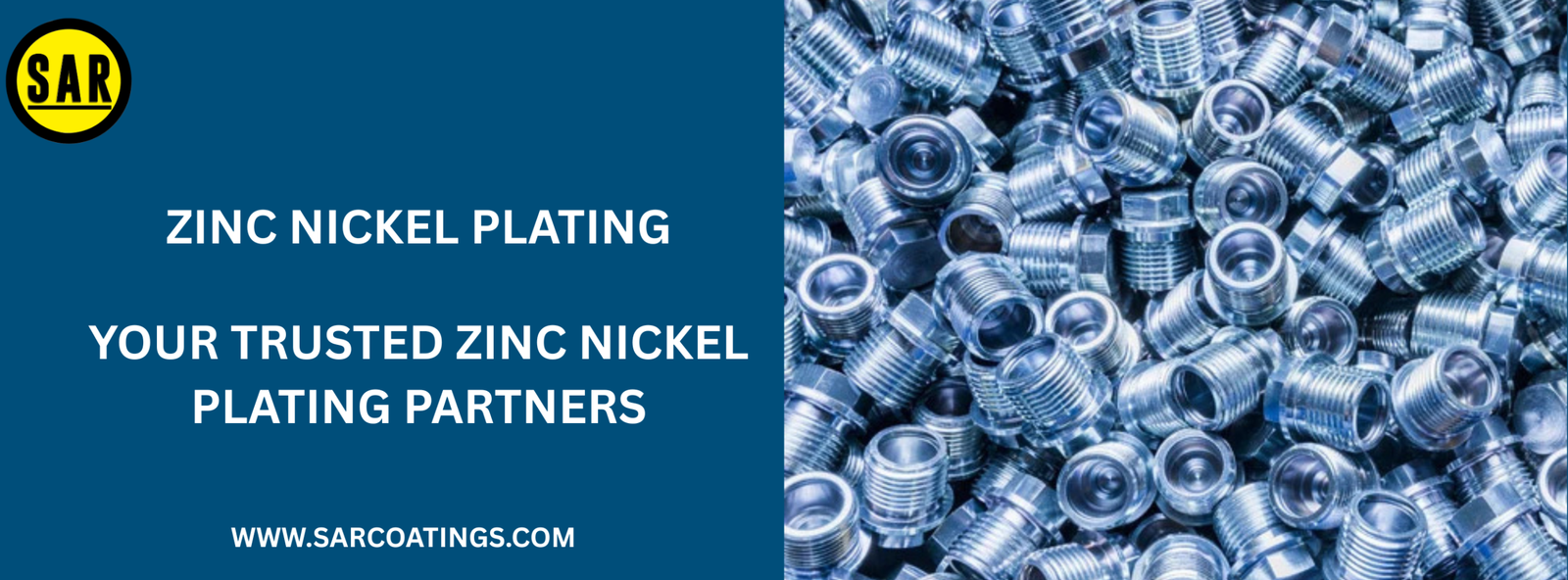
Zinc Nickel Plating : 7 Proven Reasons Automotive Engineers Trust It Over Standard Zinc
Zinc Nickel Plating in India is rapidly becoming the default corrosion protection specification for critical automotive components and if you are in the automotive supply chain, you have almost certainly seen it appearing more frequently on engineering drawings, purchase orders, and supplier qualification questionnaires. And for very good reason.
Corrosion is not just a surface problem. In automotive components, it is a structural failure waiting to happen. From brake calipers brackets to engine bay fasteners, under specified coatings lead to warranty claims, safety escalations, and lost OEM business. Standard zinc plating the workhorse of the industry for decades — is no longer sufficient for the performance requirements modern automotive platforms demand.
In this guide, SAR Coatings operating from our facilities in Manesar and Bawal breaks down everything you need to know: what this process is, how it works, why it outperforms conventional zinc, and what to look for in a plating partner in India.
What Is Zinc Nickel Plating? (And Why India’s Automotive Sector Can’t Ignore It)
Zinc Nickel plating is an alloy electroplating process where Zinc (Zn) and Nickel (Ni) are co-deposited simultaneously onto a steel or iron substrate from an electrolyte bath. The resulting deposit containing typically 12–15% Nickel by weight forms what metallurgists call a gamma-phase (γ) intermetallic crystal structure. This structure is what makes it fundamentally different from and dramatically superior to standard zinc.
Pure zinc deposits corrode sacrificially to protect the steel beneath. Zn-Ni does the same, but the alloy structure slows the corrosion reaction dramatically extending the coating’s protective life by 5 to 8 times compared to conventional zinc plating. According to the
international standard ISO 9227 (Corrosion Tests in Artificial Atmospheres), Zinc Nickel plated components routinely achieve 1000–1500+ hours to red rust a benchmark standard zinc cannot approach.
At SAR Coatings, we operate the preferred process for automotive applications, delivering excellent throwing power on complex geometries, consistent nickel content throughout the deposit, and significantly reduced hydrogen embrittlement risk versus acid-based systems. Learn more about the science on
Zinc Nickel Plating vs. Standard Zinc: Performance Comparison
The most common question engineers ask when evaluating Zinc Nickel plating is simple: “How much better is it, really?” The answer, supported by independent salt spray and cyclic corrosion testing, is: significantly.
| Performance Parameter | Standard Zinc Plating | Zinc Nickel Plating India |
| Salt Spray — White Rust | 72–120 hours | 500–720 hours |
| Salt Spray — Red Rust (ISO 9227) | 120–200 hours | 1000–1500+ hours |
| Max Temperature Resistance | ~120°C | Up to 200°C |
| H₂ Embrittlement Risk | Moderate (acid process) | Low (alkaline process) |
| Nickel Alloy Deposit | None | 12–15% Ni (gamma phase) |
| Cadmium Replacement | No | Yes — globally approved |
| RoHS / REACH Compliance | Yes (trivalent) | Yes — fully compliant |
| High-Tensile Steel (>1000 MPa) | Requires strict controls | Safe with bake relief |
7 Proven Reasons Automotive Engineers Choose Zinc Nickel Plating in India
1. 1000+ Hours Salt Spray Protection Without Sacrificing Dimensional Accuracy
Zn-Ni achieves 1000–1500+ hours to red rust in Neutral Salt Spray (NSS) per ISO 9227 at deposit thicknesses of just 8–15 microns. This is a critical advantage: thin coatings preserve thread geometry and dimensional tolerances on precision components while massively outperforming thicker conventional coatings.
2. Proven Thermal Stability Up to 200°C
Standard zinc degrades at temperatures above 120°C. Zinc Nickel retains its corrosion protection up to 200°C making it the industry-standard choice for under-hood fasteners, brake system components, exhaust brackets, and engine bay hardware where thermal cycling is constant.
3. Trusted Safety for High-Tensile Steel Fasteners Zero Hydrogen Embrittlement
High-strength steel fasteners (above 1000 MPa / HRC 32+) are vulnerable to hydrogen embrittlement during electroplating. SAR’s alkaline Zn-Ni plating process dramatically reduces hydrogen absorption. Combined with a post-plate de-embrittlement bake per IS/DIN specifications, this makes Zinc Nickel the safe, approved choice for grade 10.9 and 12.9 fasteners.
4. Fully Compliant Cadmium-Free Replacement
Cadmium plating is now restricted underx
RoHS Directive and REACH Regulation (ECHA). Zinc Nickel plating is the globally approved, RoHS and REACH compliant replacement — offering equivalent or better protection without the toxicity. It’s now routinely specified by global OEMs as the standard cadmium-free alternative.
5. Excellent Ductility — No Cracking Under Post-Plate Deformation
The gamma-phase Zn-Ni deposit is inherently ductile. Parts can undergo post-plating pressing, assembly, and forming without coating failure critical for stampings, brackets, clips, and components deformed during assembly.
6. Versatile Finishes: Clear/Blue or Black Passivation
SAR offers both Clear/Blue and Black trivalent chromate passivation for Zinc Nickel plating. Black Zinc Nickel is increasingly specified for fasteners and structural brackets where aesthetic finish matters alongside performance with no additional paint layer required.
7. Ideal for India’s Harshest Automotive Environments
India’s automotive operating conditions coastal salt air, monsoon humidity, industrial pollution belts, and wide thermal cycles put exceptional stress on corrosion protection coatings. Zinc Nickel plating in India is uniquely positioned as the specification that meets global OEM standards while addressing the specific challenges of the Indian operating environment.
Key Automotive Applications for Zn-Ni Plating
Zinc Nickel plating is now standard specification on a wide range of components. At SAR, we plate:
- Brake caliper brackets, brake pipes, and ABS sensor housings
- Under-hood and engine bay fasteners (grade 10.9 / 12.9)
- Chassis and suspension brackets, links, and stampings
- Fuel system fittings, clamps, and hydraulic connectors
- EV battery tray hardware and motor mount fasteners
- Earthing bolts, door hinge fasteners, and body hardware
- High-strength structural fasteners across passenger & commercial vehicles
What to Look for in a Zinc Nickel Plating Partner in India
As Zinc Nickel plating adoption has grown across Indian automotive OEMs and their Tier 1 supply chains, the number of applicators has increased. But not all operations are equal. Here is what quality engineers should evaluate:
Alkaline vs. Acid Process
Alkaline Zinc Nickel systems provide better throwing power, lower hydrogen embrittlement risk, and more uniform nickel content. For automotive especially high-tensile fasteners and complex parts — alkaline is the right choice.
Nickel Content Control (12–15%)
Corrosion performance depends on maintaining 12–15% Ni within the gamma phase. Below 12% performance drops. Above 15% deposit brittleness increases. Reliable plating partners run tight bath controls with regular deposit analysis.
Trivalent Passivation Traceability
Only trivalent chromate passivation not hexavalent is RoHS/REACH compliant. Ensure batch-level traceability of passivation chemistry.
PPAP Documentation Capability
Zinc Nickel plating is a special process in automotive supply chains. Your plating partner must support Process Flow Diagrams, PFMEA, Control Plans, MSA records, and ISIR/FAIR for your PPAP submissions.
SAR Coatings: Your Trusted Zinc Nickel Plating Partners
At SAR Coatings LLP, our Zn-Ni plating capability is built specifically around the requirements of automotive OEMs and Tier 1 suppliers in the NCR and Haryana belt. We are nominated as a Potential Supplier by Maruti Suzuki India Limited a benchmark of quality credibility in the Indian automotive sector.
- Alkaline Zinc Nickel process — optimised for automotive components and high-tensile fasteners
- 12–15% Nickel deposit control — consistent gamma-phase performance, every batch
- Clear/Blue and Black passivation — trivalent, RoHS/REACH compliant
- Three manufacturing units — IMT Manesar (Units 1 & 3) & IMT Bawal (Unit 2)
- Full PPAP documentation support — PFMEA, Control Plan, ISIR/FAIR
- Serving Gurugram, Manesar, Bawal, Rewari, Delhi NCR, and pan-India
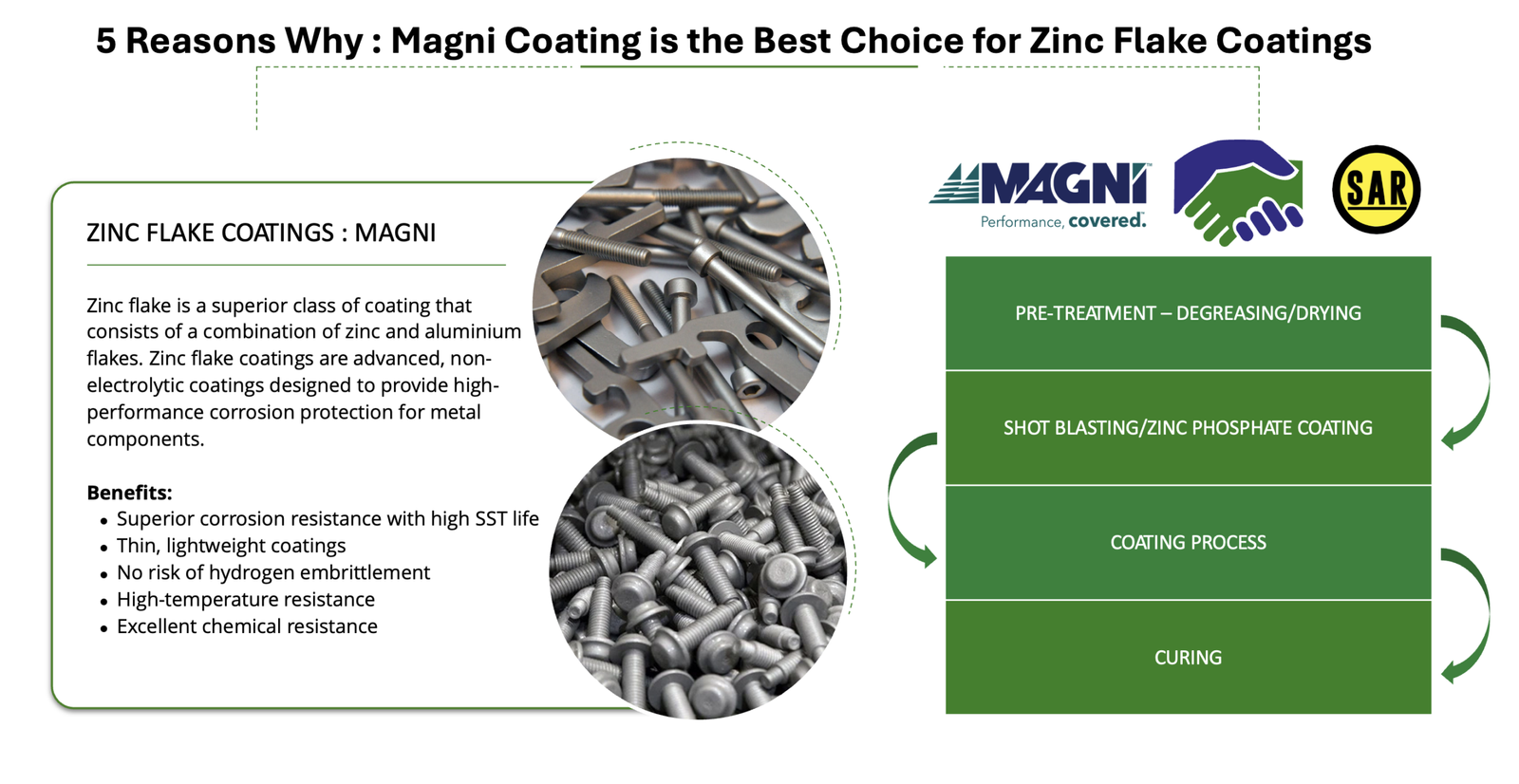
Zinc Nickel Plating vs. Zinc Flake Coating: Which Should You Specify?
Both Zinc Nickel plating and Zinc Flake coatings (like Magni) are high-performance corrosion protection systems but they serve different applications. SAR offers both, allowing us to recommend the right solution for your component and OEM specification.
| Consideration | Zinc Nickel Plating | Zinc Flake (Magni) |
| Process Type | Electroplating | Non-electrolytic dip-spin/spray |
| H₂ Embrittlement Risk | Low (alkaline) | None |
| SST Performance (red rust) | 1000–1500+ hrs | 1000–1500+ hrs |
| Temperature Resistance | Up to 200°C | Up to 240°C |
| Dimensional Accuracy | Excellent (8–15μm) | Excellent (8–20μm) |
| Best Suited For | Electroplated components, complex geometry | Fasteners, bulk/small parts |
For a detailed comparison, read our blog: [Why Magni Zinc Flake Coating Delivers 1500+ SST Hours] — an internal link to add in your CMS.
Conclusion: Zinc Nickel Plating in India Is No Longer a Premium — It’s the Standard
Zinc Nickel plating in India has crossed the inflection point. OEM drawing specifications, Tier 1 supplier quality requirements, and global regulatory frameworks have collectively made it the baseline expectation for critical corrosion-protection applications.
If your components are still on a standard zinc plating specification and facing salt spray failures, warranty escalations, or new OEM requirements, it is time to evaluate Zinc Nickel. The performance data is clear, the compliance case is established, and the right partner is in Manesar.
SAR Coatings LLP delivers proven Zinc Nickel plating from Manesar and Bawal with the process control, OEM-ready documentation, and automotive-sector experience to support your qualification and production volumes.
📩 Let’s talk about your project.
Visit our official website : https://www.sarcoatings.com/ or contact our team today.
Latest News
Zinc Nickel Plating : 7…
11/03/2026
Why Magni Zinc Flake Coating…
04/03/2026