Zinc Flake vs Zinc Nickel Coating: 4 Reasons You Must Compare Them Before You Specify
When selecting between zinc flake and zinc nickel coatings, it is crucial to understand their distinct properties and applications. Each coating offers unique advantages in corrosion resistance and performance under stress. A thorough comparison can prevent costly errors, ensuring compliance with industry standards and enhancing the reliability of automotive components. Make an informed decision to safeguard against potential failures in production and product functionality.
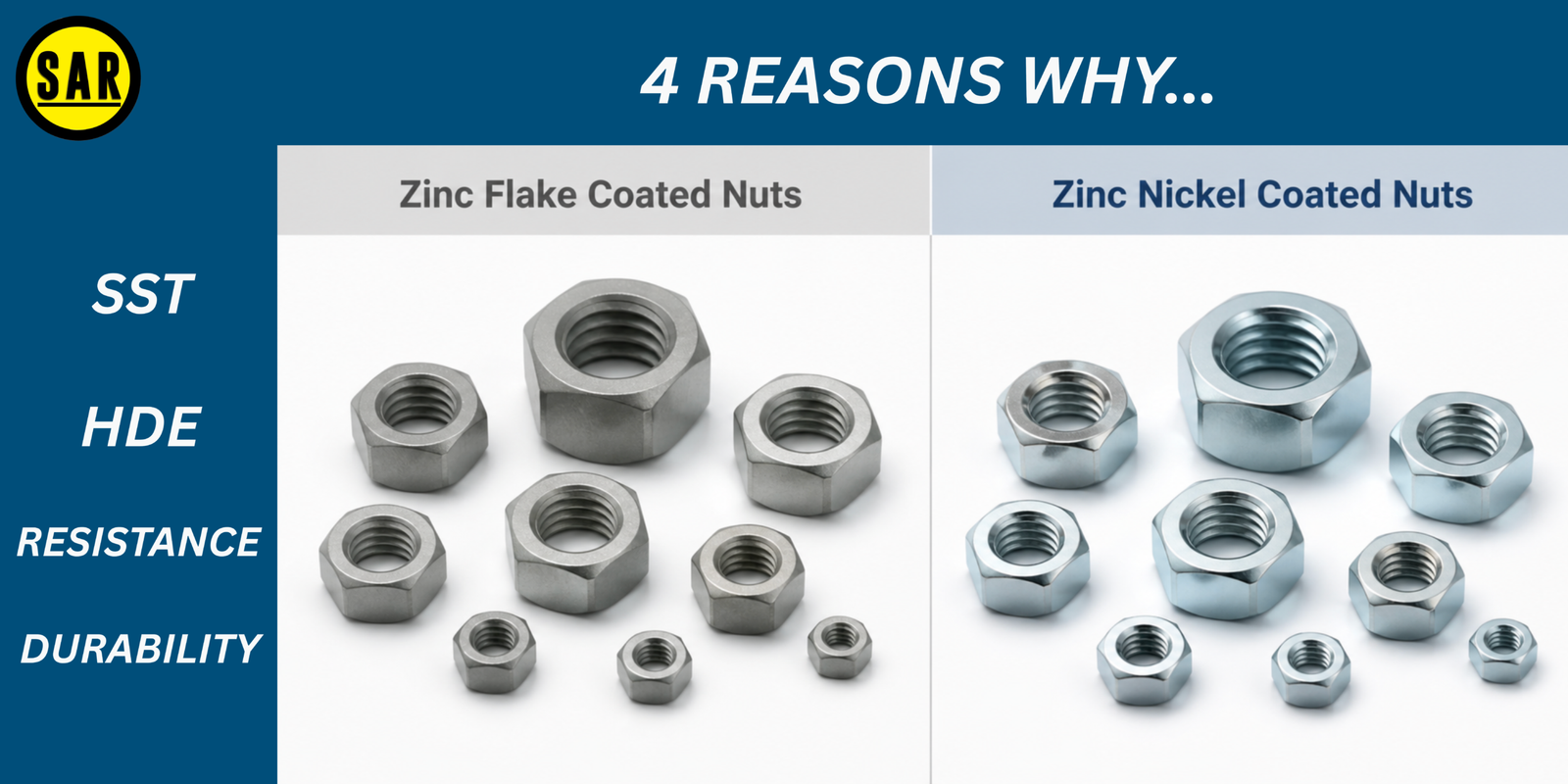
That is why Zinc Flake and Zinc Nickel deserve a side-by-side comparison, not a coin toss. They are not the same chemistry, not the same process, and not interchangeable. One is a non-electrolytic, dip-spin coating of zinc and aluminium flakes. The other is an electroplated zinc-nickel alloy. The performance gap between them only matters once you know which four numbers to look at.
Here are the four reasons every design, quality, and sourcing engineer needs to compare the two before signing off a coating callout.
Zinc Flake vs Zinc Nickel: At-a-Glance Comparison Table
| Parameter | Zinc Flake (Magni / Geomet) | Zinc Nickel (ZnNi alloy) |
| Process | Non-electrolytic (dip-spin), baked | Electrolytic (electroplating) |
| Composition | Zinc + aluminium flakes in binder | Zinc-nickel alloy, 12–15% nickel |
| Salt spray (to red rust) | 240 – 1,500 hours | 500 – 1,000+ hours (up to ~1,400) |
| Coating thickness | 8 – 15 µm | 5 – 10 µm |
| Hardness | Soft, sacrificial layer | 400 – 500 HV |
| Hydrogen embrittlement | None | Low, not zero (baking required) |
| Heat resistance | Up to ~300 °C | Excellent (holds after 200 °C+ bake) |
| Friction / torque control | Engineered, tunable (~0.10–0.18) | Less tunable |
| Relative cost | Lower | Higher |
| Plain zinc (reference) | ~120 hours salt spray | ~120 hours salt spray |
Reason 1: Corrosion Resistance — Comparing the Salt-Spray Hours
Salt-spray testing (ASTM B117 / ISO 9227, hours to first red rust) is the universal currency of corrosion protection — and it is where both coatings make their case, but for different reasons.
Plain electroplated zinc typically fails at around 120 hours. That is the baseline both of these premium systems leave far behind.
Zinc Flake systems run from 240 hours on a thin single layer up to 1,000–1,500 hours on premium multi-layer Magni and Geomet builds. They earn those hours through a barrier-plus-sacrificial mechanism: overlapping zinc-aluminium flakes physically block moisture while still sacrificially protecting the steel underneath.
Zinc Nickel delivers roughly 500 hours unpassivated at 10 µm, climbing to 720–1,000+ hours with passivates and topcoats, and advanced systems push past 1,400 hours. Its trick is the nickel content: at 12–15% nickel, the alloy corrodes far more slowly than zinc alone, combining sacrificial protection with a genuine barrier effect.
The verdict: Both are top-tier and both can clear 1,000 hours. The difference is how they get there — zinc flake through engineered layers and thickness, zinc nickel through alloy metallurgy in a much thinner film. If the only KPI is “1,000 SST hours minimum,” either satisfies it, which is exactly why the next three reasons decide the call.
Reason 2: The Coating Process & Hydrogen Embrittlement Risk
This is the single most important reason to compare the two, because it is binary for safety-critical parts.
Zinc Flake is a non-electrolytic, dip-spin process. No electrical current, no acidic plating bath driving hydrogen into the metal. The result: effectively zero hydrogen embrittlement risk. This is precisely why zinc flake is the default for high-strength fasteners — property class 10.9 and 12.9, anything above roughly 1,000 MPa tensile strength, springs, clips, and hardened components. No post-coat baking cycle required.
Zinc Nickel is electrolytic. The plating bath generates hydrogen, some of which can diffuse into high-strength steel and cause delayed, brittle failure. Its embrittlement risk is lower than plain zinc, but it is not zero. For high-strength parts it requires a controlled post-plating bake to drive hydrogen back out — an extra process step, extra cost, and extra room for error. Above ~1,200 MPa, zinc flake remains the safer choice.
The verdict: If the part is a high-strength fastener or hardened component, this reason can override everything else. Zinc flake eliminates the risk by design; zinc nickel manages it with a baking step you must validate every batch.
Reason 3: Coating Hardness, Thickness & Dimensional Fit
Corrosion is not the only enemy. Handling, assembly, vibration, and tight tolerances all punish a coating before the part ever sees salt.
Zinc Nickel is hard — 400 to 500 HV on the Vickers scale, versus roughly 100 HV for plain zinc and a soft, sacrificial zinc-flake layer. That hardness means a zinc-nickel finish survives repeated handling, assembly torque, and abrasion without being scraped off. Add its thin, uniform 5–10 µm deposit, and it becomes the better choice for parts with tight thread tolerances, fine pitches, or complex geometry needing even coverage in recesses and blind holes.
Zinc Flake, at 8–15 µm, is thicker and softer. It can be marred during rough handling and can build up on fine threads. That extra thickness is a strength for corrosion life, but a liability where dimensional precision and mechanical durability are the priority.
The verdict: For precision-machined parts, fine threads, complex shapes, and components handled and assembled hard, zinc nickel's hardness and thin uniform film win. For bulk fasteners where corrosion life beats dimensional finesse, zinc flake's thicker layer is an advantage.
Reason 4: Heat Resistance & Friction / Torque Control
A coating does not live on a salt-spray chart. It lives under a bonnet, in a brake assembly, or on a torque-controlled bolted joint where heat and friction decide whether the joint holds.
Heat: Zinc Flake stays stable up to roughly 300 °C, comfortable in most under-body and engine-bay environments. Zinc Nickel's heat performance is outstanding in a different way — it withstands a bake above 200 °C for four hours and still delivers around 800 salt-spray hours, which is why it holds where sustained heat and corrosion attack together, such as brake hardware and exhaust-adjacent components. Zinc nickel also conducts electricity well where grounding or bonding matters.
Friction: This is zinc flake's quiet superpower. Its topcoats can be formulated with integrated lubricant to deliver a controlled, repeatable coefficient of friction — typically around 0.10 to 0.18 (per ISO 16047 / ISO 10683 friction classes). For any torque-to-tension critical joint, that predictability is gold: consistent clamp load and resistance to warm-loosening. Zinc nickel's friction is less easily tuned and usually needs a supplementary topcoat or sealant to dial in.
The verdict: If your part lives in sustained high heat with corrosion, lean zinc nickel. If your part is a torque-critical bolted joint that demands a defined, repeatable K-factor, zinc flake's engineered friction is purpose-built for it.
Zinc Flake vs Zinc Nickel: Which Coating Should You Choose?
There is no universal winner — and any supplier who tells you otherwise is selling the only line they happen to run. The honest answer is that they are complementary, and the right choice depends on your part.
When to Choose Zinc Flake
- The part is a high-strength fastener (class 10.9 / 12.9, >1,000 MPa) and hydrogen embrittlement is a non-negotiable risk
- You need a defined, repeatable coefficient of friction for torque-controlled assembly
- The OEM spec calls out Cr(VI)-free Magni or Geomet systems
- You need the highest salt-spray life and high-temperature stability on bulk threaded parts
When to Choose Zinc Nickel
- Parts face mechanical wear, abrasion, and rough handling during assembly
- Tight thread tolerances, fine pitches, or complex geometry demand a thin, uniform deposit
- The component sees sustained heat combined with corrosion (brakes, under-hood)
- Electrical conductivity or a bright / satin cosmetic finish is required
Why SAR Coatings Applies Both Zinc Flake and Zinc Nickel
Most coating shops specialise in a single technology — so their recommendation is, inevitably, whatever they can apply. At SAR Coatings LLP, we operate both an in-house Zinc Flake (Magni) line and a Zinc Nickel plating line, validated to OEM and Tier-1 standards and trusted by names like Maruti Suzuki, Toyota, and Tata Motors.
That means when you bring us a part, our engineers recommend the coating your component actually needs — not the only one we can run. Want the deeper data? Read why Magni zinc flake delivers up to 1,500 SST hours and how zinc nickel clears the 1,000-hour salt-spray mark.
Not sure which your part needs? Talk to our experts, send us your drawing and corrosion spec, and we will tell you straight which of the two is right, and why.
Frequently Asked Questions
Is zinc nickel better than zinc flake?
Neither is universally better. Zinc nickel is harder (400–500 HV) and thinner, winning on wear resistance and tight tolerances. Zinc flake carries zero hydrogen embrittlement risk and offers engineered friction control, winning on high-strength fasteners and torque-critical joints. The right choice depends on the part.
Which coating has more salt-spray resistance?
Both can exceed 1,000 hours. Premium zinc flake systems (Magni / Geomet) reach 1,000–1,500 hours through multi-layer builds; zinc nickel reaches 500 hours unpassivated and 1,000+ hours with passivates and topcoats. Plain zinc, by comparison, fails at around 120 hours.
Why is zinc flake preferred for high-strength fasteners?
Because its non-electrolytic dip-spin process introduces no hydrogen into the steel, eliminating hydrogen embrittlement risk. Zinc nickel is electrolytic and requires post-plating baking to manage that risk on high-strength parts.
Is zinc flake or zinc nickel more expensive?
Zinc nickel is generally the more expensive of the two, owing to the alloy plating process and post-treatment steps. Both, however, are highly cost-effective against stainless steel for equivalent corrosion life.
Latest News
Why Corrosion Protection Is a…
30/09/2026
Why Surface Cleanliness Matters Before…
16/09/2026