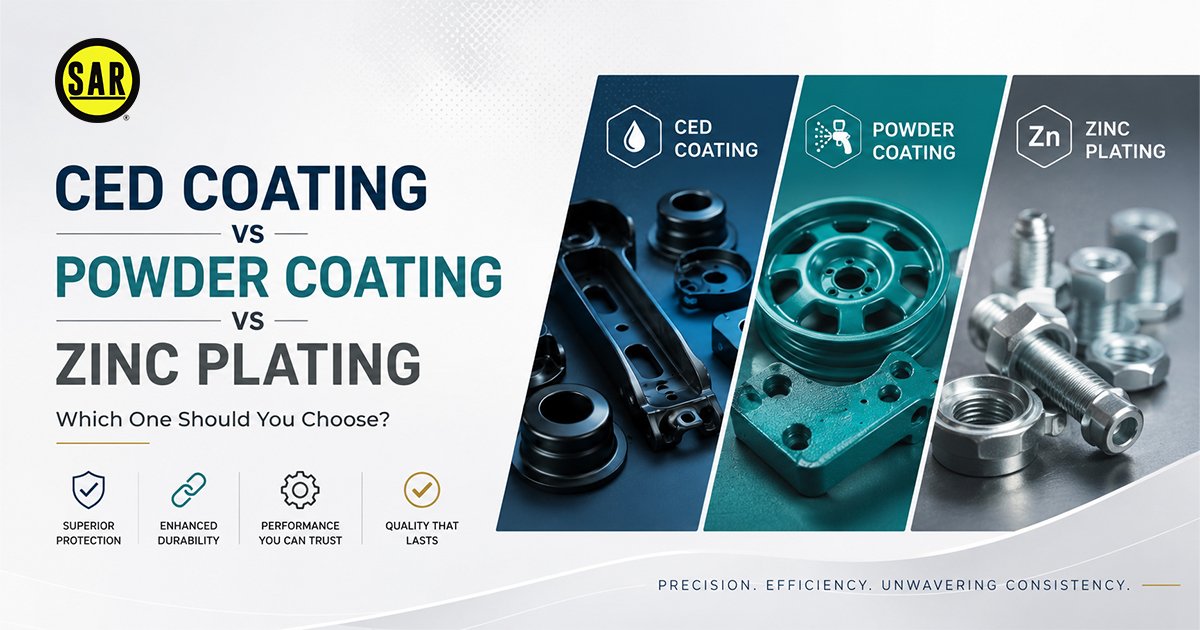
CED Coating vs Powder Coating vs Zinc Plating: Which One Should You Choose?
Choosing the right surface treatment process is one of the most important decisions a manufacturer or OEM buyer will make for their components - get it wrong, and you're looking at premature corrosion, warranty claims, line rejections, the whole list of problems nobody wants. Get it right, and your components will outlast their design life without any surprises.
The three processes that come up the most in this decision are CED (Cathodic Electro-Deposition) Coating, Powder Coating, and Zinc Plating. Each one has its own process, performance profile, and ideal use case, and, honestly, a lot of buyers mix them up or assume one is just a "better" version of the other, which isn't really true. This guide breaks down the differences so you can match the right process to your component.
Quick Comparison Overview
| Factor | CED Coating | Powder Coating | Zinc Plating |
| Process type | Electro-deposition (dip + electric current) | Electrostatic spray + baking | Electrolytic deposition |
| Corrosion resistance | Excellent, especially on complex geometries | Good to excellent, depends on the surface | Good, varies by chromate passivation |
| Coverage on hidden/internal surfaces | Excellent, uniform even in cavities | Limited, it's a line-of-sight process | Good |
| Typical film thickness | 15-25 microns | 60-120 microns | 5-25 microns |
| Best for | Chassis parts, brackets, complex shapes | Flat/exposed panels, appliance housings | Fasteners, small hardware, brackets |
| Finish/aesthetics | Uniform, primer-grade | Wide color/texture range | Bright to matte finish |
| Relative cost | Medium | Medium | Low to medium |
What is CED Coating?
CED coating, also called e-coating, works by dipping the component into a water-based paint bath and running an electric current through it, which uniformly coats every surface, including recesses, welds, and internal cavities that a spray gun just can't reach, no matter how good the operator is.
This is why it's the go-to for automotive chassis components, brackets and structural parts that face harsh under-body conditions, because corrosion usually starts in the hidden corners first, not the visible surfaces.
What is Powder Coating?
Powder coating is a dry, electrostatically charged powder that's applied to a component and then cured under heat, forming a hard and pretty durable finish. It's known for its thick coatings and the huge range of color and texture options available, which is why it's so popular for enclosures, panels, and appliance housings, where how it looks matters almost as much as how well it protects.
The catch is that powder coating is line-of-sight, so if your part has complex geometry with internal cavities or tight recesses, you won't get the same uniform coverage that CED coating gives you.
What is Zinc Plating?
Zinc plating is an electrolytic process where a thin layer of zinc gets deposited onto steel or iron components. The zinc works as a sacrificial layer, meaning it corrodes before the base metal does and takes the damage so the actual part doesn't have to. It's the standard choice for fasteners, small brackets, and high-volume hardware- basically anywhere cost efficiency and reliable baseline corrosion protection matter more than film thickness or how the part looks.
Which One Should You Choose?
- Choose CED coating if your component has a complex shape, internal cavities, or welds, and it's going to face prolonged exposure to moisture, road salt, or harsh environments generally - think chassis parts, sub-frames, structural brackets, that kind of thing.
- Choose powder coating if the part is mostly flat or externally exposed and appearance or color consistency is a priority for you - enclosures, panels, housings fall in this bucket.
- Choose zinc plating if you're coating high volumes of small hardware like fasteners, clips, and brackets, where cost per part and consistent baseline corrosion resistance matters more than anything else.
A lot of manufacturers, in real-world applications, actually combine processes - using zinc plating on the fasteners and CED coating on the chassis they're attached to, for example, so they can optimize cost and performance together across the whole assembly rather than picking just one process for everything.
Why This Decision Matters for OEM Suppliers
For Tier 1 and Tier 2 suppliers working with automotive OEMs, picking the wrong coating isn't just a part-failure risk; it can also mean failing OEM-mandated salt spray test (SST) requirements, and that alone can hold up approvals and shipments for weeks. Working with a coating partner that offers multiple processes under one roof, instead of just one, means your process gets selected based on what the part actually needs, not on what the vendor happens to offer.
SAR Coatings: One Partner, Every Process
SAR Coatings LLP offers CED coating, powder coating, zinc plating (rack and barrel), zinc flake, zinc-nickel, liquid painting, and hybrid coating, all from ISO-compliant facilities that are trusted by OEMs including Maruti Suzuki, Tata Motors, Mahindra, and Hyundai. This means your components get the right process for the job, engineered and tested to OEM spec, without you having to switch vendors for every single part.
Need help choosing the right coating for your component? Contact SAR Coatings for a technical consultation.
Latest News
Why Corrosion Protection Is a…
30/09/2026
Why Surface Cleanliness Matters Before…
16/09/2026