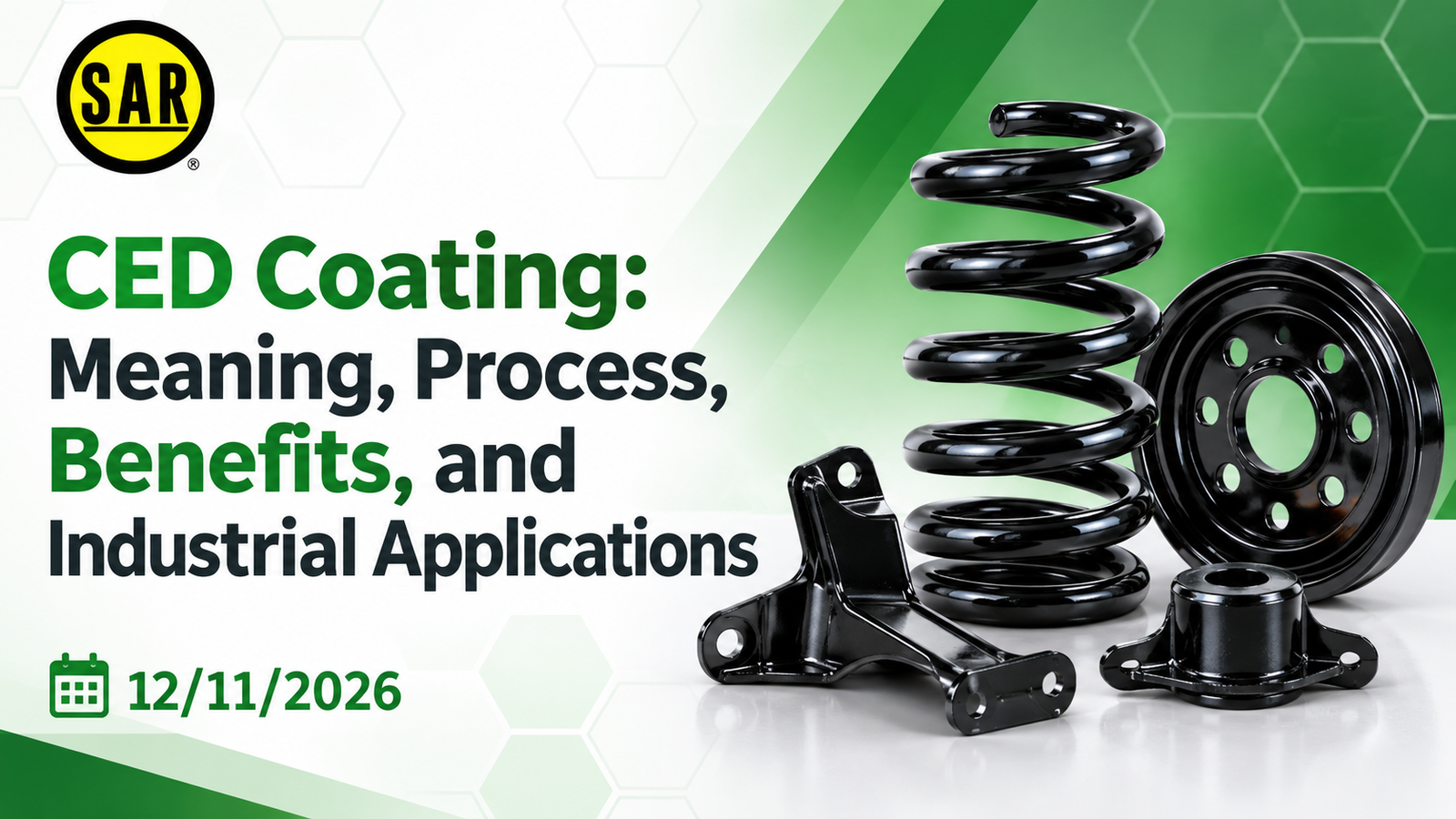
CED Coating: Meaning, Process, Benefits, and Industrial Applications
Corrosion protection in modern manufacturing is crucial for ensuring the quality, longevity, and functionality of metal parts. For industries like automotive, electrical equipment, engineering and manufacturing, advanced surface treatment technologies are required that offer the consistent protection they need against rust and environmental exposure. Ced coating is among the common technologies employed with these purposes.
This high-tech coating process delivers outstanding corrosion protection, uniform application and application efficiency, and can be used on complicated metal parts. SARCoatings offers surface protection and lasting performance with professional coatings tailored to meet industrial needs.
Familiarity with the technology, its use and the overall coating process enables the manufacturers to select the appropriate surface treatments for the product.
The question that remains is, what is CED Coating?
CED is Cathodic Electro Deposition, a new type of paint coating process that is done by applying electrical current onto conductive metal surfaces. It's also called electrodeposition coating or e-coating.
It consists of dipping metal elements into a special paint bath and charging them. This pulls the particles of the coating toward the surface of the metal and creates a uniform coating.
The technology is especially suited for components that have complex shapes, internal cavities, corners, and inaccessible places. Electrodeposition offers superior uniformity of coating and uniform coverage of the various sections of the surface as compared with the normal painting technique.
This is used as a primer coating or protective coating by manufacturers before going through further finisher treatments.
What does CED Coating Mean? Know the Technology
When we consider the mechanism of electrical deposition, the ced coating meaning of the ced coating becomes more apparent.
For cathodic electrodeposition, the metal part is used as the cathode (negative electrode). With the application of an electrical voltage, positively charged coating particles in the paint bath are drawn toward the piece.
These particles settle on the metal, eventually forming a layer. The thicker the coating, the more electrical resistance, which aids in making the deposition process self-limiting.
This mechanism offers a number of benefits:
- Even coating on complicated parts.
- Good coverage in recessed areas and cavities.
- Consistent coating quality.
- Good adhesion with suitable metal surfaces.
- Applicable coating in an efficient manner with less material loss.
- Improved corrosion protection.
A particular advantage of the technology is that it is well suited to manufacturers who need to apply surface protection to a high volume of production items.
The CED Coating Process is an understanding of the process.
There are several steps in the ced coating process that must be carefully controlled. Each stage plays a role in adhesion, corrosion protection and product quality.
1. Surface Preparation
Any work you do with your surface must begin with surface preparation. All metal surfaces should be cleaned of oil, grease, dust, rust and other impurities.
Preparation may involve degreasing, rinsing and surface conditioning depending on the material and application needs.
The coating particles must have the ability to adhere properly to the metal surface; proper cleaning is essential.
2. Pretreatment
Cleaned components have to be subjected to some pretreatment to enhance their corrosion resistance and the adhesion of the coating.
Typical pretreatment consists of chemical conversion processes that are used to form an appropriate surface for paint application.
It is important to mention that for the same substrate, environmental and performance specific criteria may result in different technologies being employed in the modern pretreatment system.
3. Electrodeposition
For electrodeposition, components are dipping into an electrolyte bath prepared specifically for this type of coating.
A voltage is applied to the component between the component and counter-electrodes. The particles migrate to the metal surface and get deposited in uniform distribution.
This stage is tasked with producing the protective coating layer – even in complex geometries.
4. Rinsing and Recovery
Once deposited, the components are taken out of the bath, and rinsed off to remove any excess coating material.
With the use of advanced systems, color particles can be caught during rinsing and added to the coating bath to increase material utilization and minimize waste.
5. Curing and Baking
The coated parts are moved to a curing oven.
Curing time and temperature are controlled so the coating film can achieve its ultimate characteristics, such as adhesion, hardness and durability.
The coating properties must be obtained through an appropriate curing process.
6. Quality Inspection
The last phase is the inspection of coated parts for conformance to quality requirements.
Common parameters for inspection include coating thickness, visual appearance, adhesion, and corrosion resistance.
Quality control is the process of ensuring the quality of the final product according to the customer's requirements and industrial specifications.
The primary advantages of CED Coating are:The key benefits of CED Coating are:
Electrodeposition technology is being increasingly used across industries, because of the increased demand for advanced surface protection.
Excellent Corrosion Resistance
The primary benefit with this type of coating technology is its ability to shield metal surfaces from rust and corrosion.
The coating, when used in combination with adequate pretreatment and curing, provides a protective barrier to help prolong component life.
Uniform Coating Coverage
Complex components can have cavities, edges, recesses, and complex shapes.
Electrodeposition provides excellent coverage in these areas and assists manufacturers in obtaining uniform protection in places where spray painting can be difficult.
Improved Adhesion
Strong adhesion between the coating and metal substrate can be achieved through proper surface preparation and controlled deposition process.
This enhances the durability of the coating and decreases the probability of early coating failure.
Efficient Material Utilization
Efficient material use can be achieved through the use of the immersion-based application method and paint recovery systems.
This is a good feature for manufacturers with large scale production facilities.
Consistent Industrial Quality
Repeatable coating conditions are maintained with automated systems.
By controlling process variables properly, manufacturers can get a uniform and uniform coating thickness, appearance and performance in each batch.
CEC in the world of industry.Industrial applications of CED Coating.
The electrodeposition technology is utilized in many industries which need to protect their metal surfaces long and reliably.
Automotive Industry
Electrodeposition coatings are applied to automotive parts, metal brackets, chassis components and body structures for automotive applications.
Coating protects components from corrosion and works to ensure long life for the vehicle.
Electrical and Electronics Industry
Protective coatings are applied to metal enclosures, panels, brackets and structural elements by electrical equipment manufacturers.
The coatings will enhance the surface quality and resist environmental exposure of metal parts.
Engineering and Manufacturing
Electrodeposited coatings are applied to fabricated metal parts, assemblies and equipment by industrial machinery manufacturers.
It enables the reliable protection of products in challenging industrial situations.
Furniture and Metal Fabrication
When consistency of coating and corrosion resistance is critical, electrodeposition technology can be also applied to metal furniture, fabricated structures and other metal products.
Latest News
CED Coating: Meaning, Process, Benefits,…
12/11/2026
Why Corrosion Protection Is a…
30/09/2026