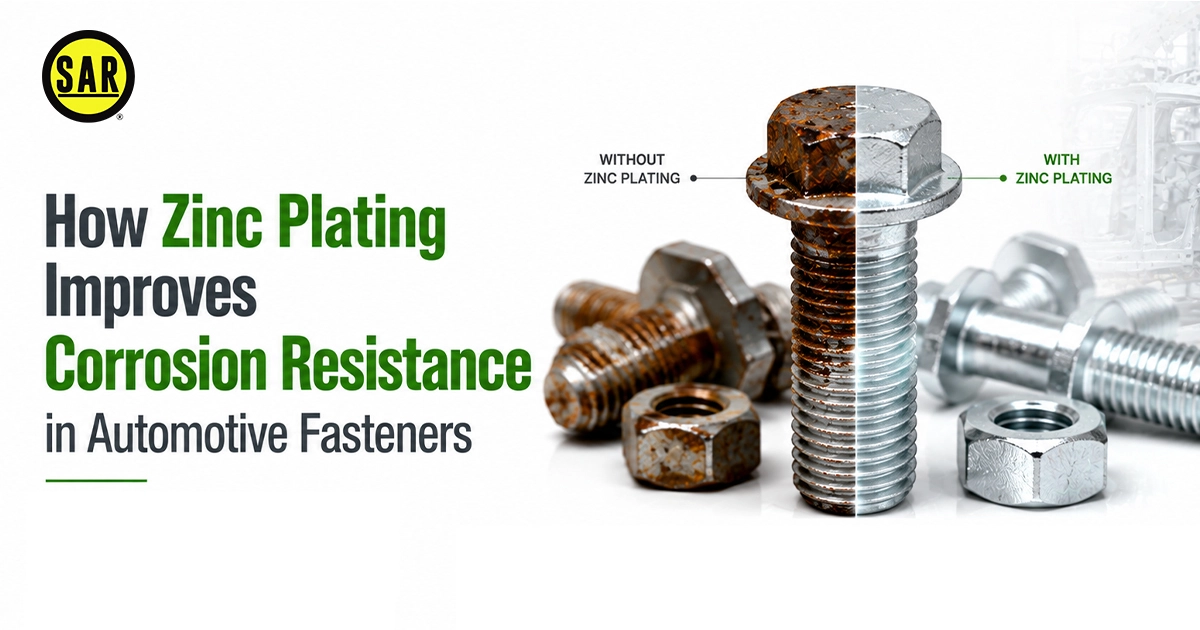
How Zinc Plating Improves Corrosion Resistance in Automotive Fasteners
A fastener is a small part with a big job. A bolt holding a suspension bracket, a nut on a chassis mount, a screw inside an engine bay - none of them look important on a bill of materials until one seizes up with rust and a technician can't remove it during a routine service.
That's the real cost of corrosion on fasteners: it's rarely catastrophic, but it's expensive in warranty claims, service time, and customer complaints. Zinc plating is the most widely used solution to this problem in automotive manufacturing, and it's worth understanding exactly why it works as it does.
Why Fasteners Corrode Faster Than You'd Expect
Fasteners face a rougher environment than most other components on a vehicle. They're exposed to road salt, moisture, temperature swings, and constant vibration - and because they're often made from carbon steel for strength, they're also more reactive to oxidation than components made from stainless alloys.
Bare steel begins to form red rust within days of exposure to humid or saline conditions. Once that rust starts, it doesn't just sit on the surface - it expands, which can loosen torque on a fastener joint and compromise the structural connection it's meant to hold.
How Zinc Plating Actually Protects the Fastener
Zinc plating works through a principle called sacrificial protection, sometimes called galvanic protection. Here's the mechanism in plain terms:
Zinc is more reactive than the steel underneath it. When moisture and oxygen reach the surface, the zinc coating corrodes first, forming zinc oxide and zinc carbonate - not red rust. The steel base metal stays protected as long as there's zinc left to sacrifice.
This is different from a barrier coating like paint, which only works as long as the coating film stays intact. If paint chips, the exposed steel rusts immediately. If a zinc coating gets a small scratch, the surrounding zinc still protects the exposed steel electrochemically. That's what makes zinc plating more forgiving in real-world handling and assembly conditions.
The Plating Process, Step by Step
- Surface preparation - Fasteners are cleaned and degreased to remove oils, scale, and contaminants that would prevent proper zinc adhesion.
- Electroplating - Parts are loaded into rack or barrel plating lines, depending on size and volume, and immersed in a zinc electrolyte bath. An electric current deposits a uniform zinc layer onto the fastener surface.
- Passivation - A chromate or trivalent chromium conversion coating is applied over the zinc layer. This step is what actually pushes corrosion resistance higher, and it also determines the finish color (clear, blue, black, or yellow).
- Sealing (optional) - A topcoat seal can be added for additional SST hours, especially for critical or high-exposure applications.
- Baking (for high-strength fasteners) - Parts above a certain hardness grade are baked after plating to reduce hydrogen embrittlement risk, a known concern with electroplated high-tensile fasteners.
Rack vs Barrel Zinc Plating for Fasteners
Fastener volume and geometry usually decide which process applies:
- Barrel plating suits small, high-volume fasteners (standard bolts, nuts, washers) that can tumble freely in bulk without damage. It's the more cost-efficient route for large production runs.
- Rack plating suits larger, more delicate, or precision fasteners where parts need to be individually fixtured to avoid contact marks or ensure coating uniformity on critical surfaces.
Trivalent vs Hexavalent Chromium - Why It Matters Now
Older zinc plating processes used hexavalent chromium (Cr6+) passivation, which delivered strong corrosion resistance but is now restricted under RoHS and REACH regulations due to toxicity concerns. Most automotive OEMs today specify trivalent chromium (Cr3+) passivation instead.
Trivalent processes have closed most of the performance gap and are the compliant standard for current automotive supply. If a vendor is still quoting hexavalent processes for automotive fasteners, that's worth flagging during vendor qualification.
What SST Hours Actually Tell You
Salt Spray Test (SST) results, run per ASTM B117 or ISO 9227, are the standard way to quantify how long a coating resists red rust under accelerated corrosion conditions. For zinc-plated fasteners, typical benchmarks look like this:
- Basic zinc plating (no additional topcoat): 96–150 hours to red rust
- Zinc plating with trivalent passivation: 150–300 hours
- Zinc plating with passivation plus sealant topcoat: 300–500+ hours
Higher SST hours generally correlate with longer field life, but the right number depends on the application — an interior fastener has very different exposure than one mounted near the underbody or wheel well.
Where Zinc Plating Fits - and Where It Doesn't
Zinc plating is well suited for:
- Standard structural fasteners (chassis, body, interior mounts)
- Fasteners requiring precise torque-tension consistency
- High-volume components where cost-per-part matters
For fasteners facing extreme underbody exposure, off-road use, or very long warranty periods, zinc-nickel plating or zinc flake coatings (such as Magni or Geomet systems) typically outperform standard zinc plating, often reaching 500 -1,000+ SST hours. The right choice comes down to matching the coating to the exposure the fastener will actually see in service, not defaulting to the same spec across the whole BOM.
Key Takeaway
Zinc plating remains the backbone of automotive fastener corrosion protection because it provides sacrificial protection, not just a surface barrier - and because it scales efficiently in high-volume production. But the passivation type, sealant, and SST target need to match the fastener's actual exposure conditions, not a generic spec carried over from a previous program.
Latest News
Why Surface Cleanliness Matters Before…
16/09/2026
How Coating Thickness Impacts Corrosion…
07/09/2026