How Coating Thickness Impacts Corrosion Protection and Component Performance
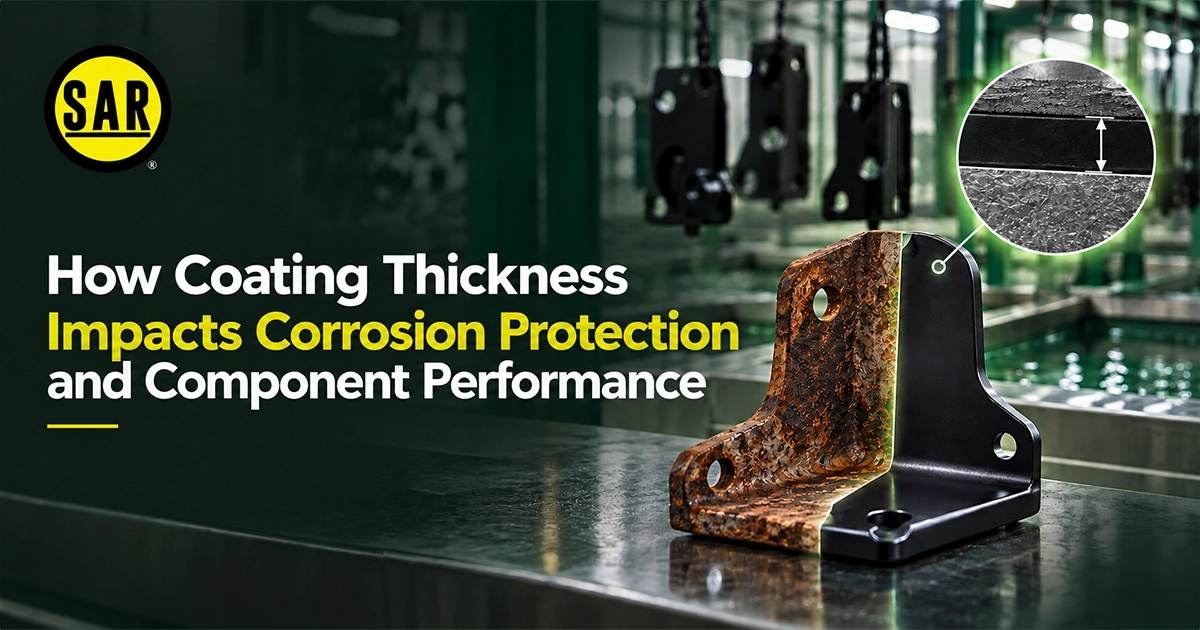
Coating thickness is one of the most important parameters in industrial surface treatment. It directly influences corrosion resistance, dimensional accuracy, adhesion, wear performance, appearance, and the overall service life of a metal component.
For automotive components, fasteners, engineering parts, brackets, structural components, and other metal products, selecting the correct coating thickness is not simply about applying a thicker protective layer. The coating must be thick enough to provide the required protection while remaining within the component's dimensional and functional requirements.
A coating that is too thin may provide inadequate corrosion protection, while excessive coating thickness can affect threads, fits, tolerances, friction, assembly, and component performance.
This guide explains how coating thickness affects corrosion protection and component performance, the factors that determine the required thickness, and why accurate coating-thickness control is essential for industrial applications.
What Is Coating Thickness?
Coating thickness refers to the thickness of the protective layer deposited or applied over the surface of a metal component.
Depending on the surface treatment process, the coating may consist of:
- Zinc
- Zinc-nickel alloy
- Zinc and aluminium flakes
- Electrodeposited paint
- Powder coating
- Liquid paint
- Other engineered protective coating systems
Coating thickness is generally measured in micrometres (µm).
For industrial components, the required coating thickness is normally determined by factors such as the base material, operating environment, corrosion requirements, component geometry, dimensional tolerances, coating technology, customer specifications, and applicable standards.
The objective is not to achieve the maximum possible thickness. The objective is to achieve the right thickness for the intended application.
Why Does Coating Thickness Matter?
A protective coating acts as a barrier between the metal substrate and its surrounding environment.
Moisture, oxygen, salts, chemicals, humidity, and other corrosive agents can attack an exposed metal surface. A properly selected coating system reduces this exposure and helps protect the underlying substrate.
However, coating performance depends on more than the presence of a coating.
The coating's:
- Thickness
- Uniformity
- Adhesion
- Surface preparation
- Chemical composition
- Post-treatment
- Application process
- Curing or baking conditions
can all influence its final performance.
This means that coating thickness should always be considered as part of the complete coating system rather than as an isolated specification.
How Coating Thickness Affects Corrosion Protection
One of the primary reasons for applying a protective coating is to improve corrosion resistance.
In many coating systems, increasing coating thickness can increase the amount of protective material available between the metal substrate and the corrosive environment. However, the relationship is not simply "thicker coating equals better protection."
1. Thin Coatings Can Reduce Corrosion Protection
If the coating is below the required specification, certain areas may have insufficient protective coverage.
This can become particularly important when components are exposed to:
- High humidity
- Road salt
- Coastal environments
- Industrial chemicals
- Water
- Temperature fluctuations
- Outdoor conditions
Insufficient coating thickness can reduce the coating's ability to provide the expected level of corrosion protection.
2. Uniform Thickness Is as Important as Average Thickness
An average coating thickness may meet a specification while some areas of the component remain significantly thinner.
This is particularly relevant for components with:
- Sharp edges
- Recesses
- Holes
- Threads
- Corners
- Deep cavities
- Complex geometries
Therefore, industrial coating quality is not only about achieving a target average thickness. Uniform coating distribution across critical surfaces is equally important.
For example, SAR Coatings highlights uniform coating capability for complex geometries in its CED coating operations.
Does a Thicker Coating Always Mean Better Corrosion Protection?
No.
This is one of the most important concepts in industrial coating selection.
A thicker coating can provide additional material for protection in some coating systems, but excessive thickness can create other problems.
For example, excessive coating buildup may affect:
- Component dimensions
- Thread engagement
- Hole diameter
- Press fits
- Moving interfaces
- Assembly tolerances
- Friction
- Appearance
- Coating adhesion or curing characteristics
Therefore, the correct engineering approach is to specify a required coating thickness range, rather than simply requesting the thickest possible coating.
The appropriate thickness should be determined according to the coating technology, application environment, component geometry, and required performance.
Coating Thickness and Dimensional Accuracy
Dimensional accuracy is particularly important for precision-engineered components.
When a coating is applied to a component, it adds material to the surface.
Even a relatively small increase in thickness can influence critical dimensions when:
- Threads are fine
- Clearances are tight
- Components require precise fits
- Parts are assembled with mating components
- Shafts or bores have controlled tolerances
For example, excessive coating buildup on a threaded fastener can change thread dimensions and affect assembly.
This is why coating thickness control is critical for automotive fasteners, precision components, engineering parts, and other applications where dimensional tolerances are tightly controlled.
The ideal coating therefore provides the required corrosion protection without unnecessarily affecting the original component dimensions.
Impact of Coating Thickness on Component Performance
Coating thickness can influence more than corrosion resistance.
Depending on the application and coating technology, it can affect several important performance characteristics.
1. Corrosion Resistance
The most obvious impact is protection against corrosion.
The coating creates a protective layer that helps isolate the substrate from environmental exposure.
For sacrificial systems such as zinc-based coatings, the coating can also provide additional protection to steel through preferential corrosion of the zinc layer.
2. Wear Resistance
In applications where components experience friction or repeated contact, the coating system must be selected according to the required wear performance.
Simply increasing coating thickness is not necessarily a substitute for selecting a coating technology designed for the application's mechanical conditions.
3. Friction and Torque
For fasteners, coating thickness and coating composition can influence friction characteristics.
This can become important in applications where controlled tightening torque is required.
An uncontrolled increase in coating thickness may also affect the interaction between mating surfaces.
4. Assembly Performance
Coating buildup can affect:
- Threads
- Press fits
- Mating surfaces
- Holes
- Clearances
- Fastener engagement
For mass-produced components, even small dimensional changes can create assembly problems or increase rejection rates.
5. Appearance
Coating thickness and process control can also influence the visual consistency of a finished component.
Depending on the coating technology, excessive or uneven coating can result in variations in:
- Surface appearance
- Gloss
- Colour
- Texture
- Edge coverage
Coating Thickness Across Different Surface Treatment Processes
Different coating technologies require different approaches to thickness control.
There is no single coating thickness that works for every industrial application.
Zinc Plating
Zinc plating provides corrosion protection to steel and iron components through a combination of barrier and sacrificial protection.
Its relatively controlled deposit makes it suitable for many applications where corrosion protection must be balanced with dimensional requirements.
The required zinc plating thickness depends on:
- Corrosion requirements
- Component geometry
- Base material
- Dimensional tolerance
- Required finish
- Customer specification
SAR Coatings' zinc plating process includes controlled deposition followed by post-treatment and inspection, with coating thickness being one of the key quality parameters.
Zinc Nickel Plating
Zinc-nickel plating is used when higher corrosion performance is required while maintaining relatively controlled coating thickness.
It is particularly relevant to demanding automotive and industrial applications where both corrosion protection and dimensional control are important.
SAR Coatings describes zinc-nickel systems as a high-performance alloy coating technology used for demanding applications.
Zinc Flake Coating
Zinc flake coatings use zinc and aluminium flakes within a binder system and are applied without conventional electrolytic deposition.
One of their advantages is the ability to provide strong corrosion protection at relatively low coating thicknesses.
SAR Coatings' published comparison, for example, lists zinc-flake systems in the approximate 8–15 µm range for the compared systems, while noting that actual requirements depend on the coating specification.
CED / E-Coating
Cathodic electrodeposition coating, commonly known as CED or e-coating, is designed to provide consistent coverage across metal components, including complex areas.
The coating thickness can be controlled through process parameters such as voltage and process conditions.
Uniformity is particularly valuable where components have complex shapes or areas that can be difficult to coat using conventional spray techniques.
What Determines the Required Coating Thickness?
There is no universal thickness suitable for every component.
Engineers and manufacturers should consider several factors before defining a coating specification.
1. Operating Environment
Where will the component be used?
A component operating in a dry indoor environment may have very different corrosion requirements from one exposed to:
- Coastal air
- Road salt
- High humidity
- Industrial pollutants
- Chemicals
- Outdoor weather
The more aggressive the environment, the more carefully the coating system and performance requirements need to be evaluated.
2. Base Material
The substrate material influences the surface preparation, coating compatibility, and corrosion behaviour.
Steel, high-strength steel, cast components, and other substrates may require different treatment strategies.
3. Component Geometry
Geometry has a major influence on coating distribution.
Complex components can contain areas where achieving uniform coating thickness is more difficult.
Engineers should therefore consider the coating process during component design whenever possible.
4. Dimensional Tolerances
If a component has tight dimensional tolerances, coating thickness must be carefully controlled.
Critical areas such as threads, bores, mating surfaces, and precision fits may require special attention.
5. Required Corrosion Performance
The coating specification should be linked to the required corrosion performance rather than selecting thickness independently.
Salt spray testing can be used as one method for evaluating coating performance under controlled accelerated conditions, although salt spray hours should not be interpreted directly as real-world service life.
6. Customer and Industry Specifications
Automotive and industrial manufacturers frequently define specific coating systems, thickness ranges, corrosion requirements, appearance requirements, and inspection criteria.
These requirements should be established before production begins.
How Is Coating Thickness Measured?
Accurate coating-thickness measurement is an important part of industrial quality control.
Depending on the coating and substrate, different measurement methods can be used.
Common approaches include:
Magnetic Thickness Measurement
Magnetic methods are widely used to measure non-magnetic coatings on ferrous substrates.
Eddy Current Measurement
Eddy current techniques can measure certain non-conductive coatings or conductive coatings over non-ferrous substrates, depending on the measurement system.
Microscopic or Cross-Sectional Measurement
Cross-sectional analysis can be used when detailed examination of the coating structure and thickness is required.
The appropriate measurement technique depends on:
- Coating type
- Substrate material
- Required accuracy
- Component geometry
- Applicable standard
- Customer specification
Coating Thickness vs Salt Spray Performance
Salt Spray Testing, or Neutral Salt Spray (NSS), is commonly used to evaluate the corrosion resistance of coated components under accelerated laboratory conditions.
However, coating thickness should not be considered the only factor determining salt spray performance.
Other factors include:
- Coating chemistry
- Surface preparation
- Coating uniformity
- Passivation or topcoat
- Coating adhesion
- Substrate condition
- Process control
- Test requirements
For example, SAR Coatings notes that actual corrosion performance depends on multiple factors, including coating thickness, surface preparation, environmental exposure, and mechanical damage.
Therefore:
Higher coating thickness does not automatically guarantee proportionally higher salt spray performance.
The entire coating system must be evaluated.
Common Problems Caused by Incorrect Coating Thickness
Incorrect coating thickness can create both quality and production problems.
If the coating is too thin:
- Corrosion protection may be inadequate
- Early corrosion may occur
- Salt spray performance may not meet specifications
- Critical areas may have insufficient coverage
- Component service life may be reduced
If the coating is too thick:
- Threads may become difficult to assemble
- Dimensional tolerances may be affected
- Mating components may not fit correctly
- Friction characteristics may change
- Coating buildup may occur at edges or recesses
- Appearance may become inconsistent
- Unnecessary coating material may be consumed
The goal is therefore controlled and consistent coating thickness, not maximum thickness.
How Manufacturers Can Improve Coating Thickness Control
Manufacturers can improve coating consistency by controlling the entire surface-treatment process.
Important practices include:
Proper Surface Preparation
Cleaning, degreasing, activation, and other pretreatment steps help create a suitable surface for coating.
Process Parameter Control
Parameters such as voltage, current density, bath chemistry, coating time, temperature, and curing conditions can influence coating deposition depending on the process.
Component Loading and Positioning
The way components are positioned during processing can influence coating distribution, particularly for complex geometries.
Regular Thickness Inspection
Coating thickness should be measured at defined locations using appropriate inspection equipment.
Process Monitoring
Consistent monitoring helps identify process variations before they result in large batches of non-conforming components.
Defined Acceptance Criteria
Thickness requirements should clearly specify:
- Minimum thickness
- Maximum thickness where applicable
- Measurement locations
- Measurement method
- Applicable standard
- Sampling requirements
This creates a measurable and repeatable quality-control system.
Why Uniform Coating Thickness Matters for OEMs and Tier-1 Suppliers
For automotive OEMs and Tier-1 suppliers, coating performance is directly connected to product quality.
A coating failure can potentially lead to:
- Component rejection
- Production delays
- Rework
- Warranty concerns
- Corrosion-related failures
- Increased maintenance costs
- Customer dissatisfaction
For high-volume production, even a small process variation can affect thousands of components.
This makes process consistency and coating-thickness control critical parts of industrial surface treatment.
The focus should therefore be on maintaining a repeatable process rather than simply achieving a target thickness on individual samples.
How to Select the Right Coating Thickness
Before finalizing a coating specification, manufacturers should ask:
- What environment will the component operate in?
- What level of corrosion resistance is required?
- What is the base material?
- Are there critical dimensional tolerances?
- Does the component contain threads, holes, or tight fits?
- What coating technology is most appropriate?
- What corrosion test or performance requirement applies?
- What coating thickness range is recommended for the selected system?
- How will coating thickness be measured?
- What inspection and acceptance criteria will be used?
Answering these questions helps prevent the common mistake of selecting coating thickness based only on a single performance parameter.
Coating Thickness: The Right Balance Between Protection and Performance
The ideal coating is not necessarily the thickest.
For industrial components, the best result comes from achieving the right balance between corrosion protection, dimensional accuracy, mechanical performance, appearance, manufacturability, and cost.
A well-engineered coating specification should therefore consider the complete application rather than focusing on thickness alone.
For example, a precision fastener may require a different coating strategy from a large automotive bracket, even if both components require corrosion protection.
Similarly, a component exposed to aggressive environmental conditions may require a more advanced coating system rather than simply increasing the thickness of a conventional coating.
Frequently Asked Questions
What is the ideal coating thickness for corrosion protection?
There is no universal ideal coating thickness. The required thickness depends on the coating technology, substrate, operating environment, corrosion requirement, component geometry, dimensional tolerances, and applicable specifications.
Does a thicker coating provide better corrosion resistance?
Not necessarily. Increasing thickness can improve protection in some systems, but excessive thickness can create dimensional and functional problems. Coating chemistry, uniformity, adhesion, surface preparation, and post-treatment also strongly influence corrosion performance.
Why is coating thickness important for automotive components?
Automotive components often require a balance between corrosion resistance and tight dimensional tolerances. Excessive coating buildup can affect threads, fits, assembly, friction, and other performance characteristics.
How is coating thickness measured?
Depending on the coating and substrate, thickness can be measured using magnetic, eddy-current, microscopic, or other suitable measurement techniques.
What happens if the coating is too thin?
An insufficient coating can reduce corrosion protection and may result in premature corrosion or failure to meet the required performance specification.
What happens if the coating is too thick?
Excessive coating thickness can affect dimensions, threads, fits, assembly, friction, appearance, and process economics.
Is coating thickness the only factor affecting corrosion resistance?
No. Corrosion performance also depends on coating chemistry, surface preparation, coating uniformity, adhesion, post-treatment, substrate condition, environmental exposure, and mechanical damage.
Conclusion
Coating thickness plays a critical role in determining the corrosion protection and functional performance of industrial components.
However, the goal should never be to simply make a coating as thick as possible.
The right approach is to select a coating system and thickness that match the component's operating environment, corrosion requirements, geometry, dimensional tolerances, performance expectations, and industry specifications.
For automotive, engineering, and industrial components, accurate thickness control combined with proper surface preparation, process monitoring, and quality inspection can help deliver consistent and reliable coating performance.
At SAR Coatings, different surface-treatment technologies - including CED coating, zinc plating, zinc-nickel plating, and zinc-flake coating - can be selected according to the technical requirements of the component and its intended application.
When corrosion protection and component performance are both critical, the right coating thickness is not simply a number - it is an engineering specification that must be controlled throughout the surface-treatment process.
Latest News
Why Corrosion Protection Is a…
30/09/2026
Why Surface Cleanliness Matters Before…
16/09/2026